

Apéritif
‘There was much excited chatter as the Myrish people of Wychwold tucked into a breakfast banquet. Cold ham dripping in a thick lather of golden honey, smoked salmon on a bed of bright lettuce leaves and covered with a zealous sprinkling of dill, and rich cheeses in all tangs and tastes.’
– The Curiosities of Perciville Harper
I’m going to go out on a limb here and say that you, dear reader, are fully aware of the importance of food in our everyday lives. The nourishment, of course. The celebrations, festivities and communities, naturally. The honouring of a lost loved one through an old recipe, or the mourning of a broken relationship via a tub of ice-cream.
The point is, the food we choose to eat and the people with whom we choose to eat it is part of what makes us human. It’s one of the reason why, when archaeologists go sifting through coprolite (fossilised poo), they are so interested in the proteins and grains, frozen in time, which tell us of our ancestors’ diets.
I am currently working on the third book in my Epic Fantasy Sarsen series and, after writing two back-to-back chapters in which, among many other details, two different characters from two different backgrounds tucked into two different breakfasts, I started thinking: 1) why did I instinctively want to write about these meals and 2) will my readership actually give a fork about what these characters are eating?
And so, the writer’s train-of-thought railed me away and I found myself spiralling into a pit of ideas surrounding the question: what can a meal say in a novel?
Therefore, hold on to your spatula, pre-heat the oven, and dust off the good cutlery because I’ve got a few ponderings on the subject that might just pickle your onions.
1. Characters and their Table Manners
‘Jokandu tilted his head towards the serving boy like an owl, his eyebrows raised enquiringly, the sausage still betwixt his fingers.’
– Book 3 Sarsen series
The above quote comes from my current WIP. It was this very scene which led me to questioning this notion of what a meal can say about a character, and the above line, I think, says quite a lot. Why? Because somebody holding a sausage between their fingers evidently lacks some degree of etiquette.
What information can we extrapolate from a character who picks out all of the swede from their casserole, or who chews with their mouth open, or doesn’t chew at all?
What does it say about a character who carefully dices every slice of their steak as if they were a surgeon before taking a mouthful so small that a mouse couldn’t choke on it, or who works through a bowl of insipid fish stew just so not to insult their host?
These simple and, often, subtle actions can reveal so much about our characters. Afterall, we as readers are only humans, and humans are notoriously judgemental. Off the pages and into a restaurant, we instinctively form an opinion of a tablemate by their manners. Eating with their mouths open, holding the fork in the wrong hand, elbows on the table, serviette tucked into their shirt, slurping their soup: need I go on?
I think that maybe it’s not “you are what you eat” but “you are how you eat”.
When writing a novel, giving your characters the chance to show the reader their meal choices and table manners can say more about them than simply spelling it out in words (or alphabet spaghetti).
2. Table for One or Feasting with Friends
‘After all, breakfast was regarded as a very important meal across Marrow Myre. It wasn’t just about fuelling the body before a day of tilling the fields, tending to livestock or constructing new barns. It was about community. A social gathering that took place each and every morning, no matter the weather.’
– The Curiosities of Perciville Harper
Is your character a lone wolf, dining on a tin of baked beans alone in their studio flat (as wolves are known to do), or a social butterfly, forever at the local Wetherspoons working their way down the menu with a group of friends they’ve held onto since school?
In a similar vein to their table manners, we can learn a lot about a character whether they choose or are forced to eat alone or in the company of others. You might be thinking now, “Who would be forced to eat with other people?” Perhaps schoolchildren, or soldiers, or even prisoners come to mind.
Further to this, maybe a character does choose to eat with a group of friends but insists that no food is shared between them. Social but ordered.
Or the alternative: all the food in the middle of the table, a complete free-for-all, no plates off limit. What does this say about a community or social group? That a little chaos never did any harm in good company?
Then again, the lone wolf. Jack Reacher sipping on a coffee, James Bond at the bar with a martini, Matilda alone in the library. Hey, what about Shrek gorging on slugs and worms, for crying out loud! – it was a book first, you know.
This may not tell you everything about a character and the circumstances surrounding them but it’s still a useful mechanism to add to their overall portrait.
3. Culture
‘No sooner had breakfast started than it was all over and the villagers of Wychwold, bellies nourished to a near-comfortable level, were awaiting the morning sermon from the new town cleric which would conclude the meal.’
– The Curiosities of Perciville Harper
Food and meals are imbedded in every single culture across the world, be it the rituals before, during or after a meal, whether feasting or fasting, perhaps a dress code, a particular ornament on the table, or of course the food itself. Consequently, when it comes to enriching a culture within a novel, one meal can go long way to showing the reader all they need to know.
For rituals, it may be someone saying grace before tucking in at the table, or even just the head of the household carving a turkey.
Is there a grand feast to celebrate the new year, or must the community fast between dawn and dusk for a month?
What about the food itself? The cultural staples such as SPAM in the Philippines (it’s a real thing, look it up), cured fish in Scandinavia, the pork pie in the UK, I suppose.
On the other hand, what about the omissions from the plate which can equally be informative of a culture’s habits and rituals: no pork in Judaism, no beef in Hinduism, no nutrition in veganism.
Culture is beautifully complex and widely diverse seutee wherever you go, and plonking a family down at the table for supper can allow the reader to pull up a seat too and take part in something special.
4. Climate and Trade
‘The sage continued. “He made the absolute best coffee anywhere in the Arvum. Beans came from the Bouandan jungles, the cream from Elkensen mountain goats, and even the water came from the springs of the Precipitous Mountains. It was like drinking your greatest love affair, mixed with your wildest fantasy and warmed with your fondest memory. Even the jars in which he served it came from the potters of Rosensted…”’
– In the Heart of a Soulless Vessel
The food and drink adorning the table tell a story of their own, after all it must have come from somewhere. If your novel is set on a remote island in the Arctic Circle, I’d be somewhat miffed if a chicken korma and pilau rice were on the menu, followed by a tiramisu and accompanied with a glass of red. Instead, I’d expect to see fish, whale, even polar bear among the staples of a small community, washed down with a glass of salty water.
If the setting is somewhere in the Tropics, a bowl of mango, pineapple and dragonfruit would be more appropriate than a milky bowl of Scottish oat porridge.
In many ways, you could paint a clear picture of your book’s setting by describing only the food on the table.
That being said, we live in a strange world in which apples, bananas, kiwis and sharon fruit (whatever that is) are readily available from any supermarket, all year around. It’s quite plausible that I might sit down to a TV dinner of whale and mango stew, followed by an affogato and a piece of baklava…okay, not whale, but you get my point. Global trade means that everything is available for everyone, always, for better or for worse.
But, since trade only works alongside good, diplomatic relationships or else a colony, there is also an underlying message hidden beneath the skin of the banana that your character, sitting in an office in Berwick-upon-Tweed, is munching on: that trade is good, global relations are good, or your character is part of an empirical homogony.
5. Fauna and Flora
‘Anyway, I’m going to stake out the place. I recommend the honey fowl or the fried scorpions.’– In the Heart of a Soulless Vessel.
So far, I’ve written about what a meal can say about your characters, their local community, their culture, and the climate in which they live, both environmentally and geopolitically. This last topic looks at the creatures, critters and crops that share the world within your novel.
Bringing the topic back to the genre that I am most familiar with, worldbuilding is an integral part of an Epic Fantasy, and populating that world with fauna and flora is an essential component to adding depth and plausibility. Needless to say, the food and drink on the table invites the reader to immerse themselves further into the world, offering insights into what animals and plants occupy the landscape.
On a surface level, a sirloin steak means that, somewhere beyond the tavern where your character is feasting, there are cows roaming around a field. The thick slice of wheat bread tells the reader that wheat has been cultivated and milled. The chalice of wine means that there are grapes.
However, you can develop the worldbuilding so much further by expanding upon the spread of meats and cheeses and fruits and roots and pulses and so on and so forth. Think of it like this: if it’s on the table, it’s in the world. A sirloin steak: great, cows! How about snails or goat, swordfish or guinea fowl? Apples and pears, avocados and apricots? Do your characters sip on tea or coffee or hot cocoa? Perhaps they’re even partial to an icy glass of syrupy, carbonated extract of the coca leaf?
Ultimately, it’s possible to treat the dinner table as a menagerie of the strange and beautiful animals and plants that live in your fictious world.
Digestif
I’m sure I could go on further about the role food can play in a novel but, unfortunately, I’ve got to go and put the dinner on. Perhaps the next time you pick up a novel in which characters feast around a long table in intricate detail (George R R Martin, I’m looking at you), you’ll be able to read a little closer between the lines and extrapolate more about the world unfolding before you.
At the very least, I hope that if you are working on your own story, whether grounded in real cultures of the world or entirely new ones of your own creation, that maybe this blog will provide you with — ah, heck! I’m just going to say it — a little food for thought.
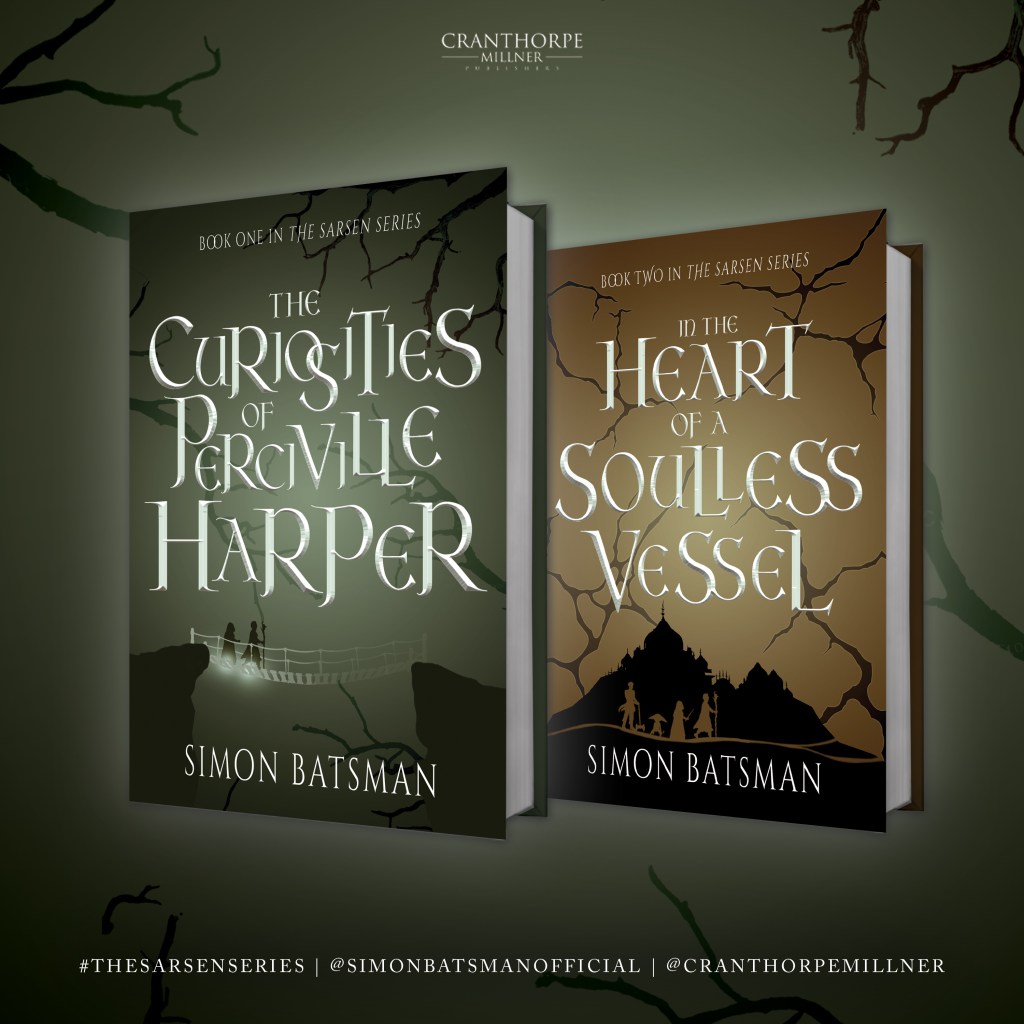

 Author of The Sarsen Series
Leave a comment